
Car Showroom Facades: Spider Glazing & ACP Fascia
Let the cars sell themselves from the road.
Frameless glass fronts and crisp ACP fascia bands that put your display floor on show, day and night, for automobile dealerships across Tamil Nadu and Kerala.
A car showroom is judged from the road long before anyone walks in. A buyer driving past should take in the display floor, the brand colours and the signage in a single glance. That is why so many automobile dealerships choose a tall, frameless glass front set below a clean ACP fascia band. At Cladex Elevations, our engineers plan and install exactly this combination: spider-glazed or structurally glazed toughened glass for the showroom face, and accurately folded aluminium composite panels for the fascia, columns and side walls.
Showroom facades also carry a corporate identity, and dealer principals are usually working from a design manual issued by the manufacturer. We study those drawings carefully, check ACP shades and finishes against the specification before ordering, and set out the glazing grid so that display cars sit unobstructed behind the glass. With more than ten years in facade work and two offices in Coimbatore, our own engineering team handles the site measurement, panel fabrication and installation for dealerships in Tamil Nadu and Kerala.
Night visibility matters as much as daytime traffic. A well-detailed glass front lets the interior lighting turn the entire showroom into a glowing display box after sunset, while the ACP fascia gives a uniform, ripple-free background for illuminated brand letters. Send us your architect's drawings or a few site photos on WhatsApp, and Er. Sanjay M. or Er. Aravind M. will arrange a site visit and a free, site-measured quote for your dealership facade.
What a car showroom facade must deliver
Uninterrupted display visibility
Large glass panes with as little framing as possible, so that vehicles on the floor are seen clearly from the road and passers-by notice the product rather than the structure holding the glass.
Brand identity compliance
Manufacturers expect consistent fascia colours, signage zones and proportions across their dealer network. The facade has to follow those guidelines with straight joint lines and flat, ripple-free panels.
Heat and glare control
A west- or south-facing glass front can overheat the display floor. Careful glass selection and canopy depth keep customers comfortable and reduce the load on the air-conditioning.
Durability beside busy roads
Traffic dust, vibration and heavy monsoon rain call for well-sealed joints, PVDF-coated ACP that resists fading, and stainless steel glazing hardware that stays tight year after year.
The right systems for car showrooms
Spider Glazing
Stainless steel spider fittings hold the toughened glass at its corners, often braced by glass fins, creating the frameless, double-height glass front that lets display cars dominate the view.
About Spider GlazingACP Signage & Fascia
A continuous ACP fascia band above the glazing carries the brand colour and gives a flat, rigid base for illuminated letters, logos and the dealer name.
About ACP Signage & FasciaStructural Glazing
Where a fin-supported spider system does not suit the structure, glass bonded to a concealed aluminium frame still keeps the outer face flush and clean.
About Structural GlazingACP Cladding
Cladding the columns, side walls and workshop block in ACP gives the whole building one consistent finish rather than a branded front on a plain shell.
About ACP CladdingOffice Glass Partitions
Glass cabins for sales managers, finance and insurance desks keep the showroom floor open while still giving customers a quiet place to close a deal.
About Office Glass PartitionsSoffit Ceiling
A neat soffit under the front projection or delivery-bay canopy hides services, houses downlights and gives the underside a finished, weather-resistant surface.
About Soffit CeilingChandra Hyundai Showroom
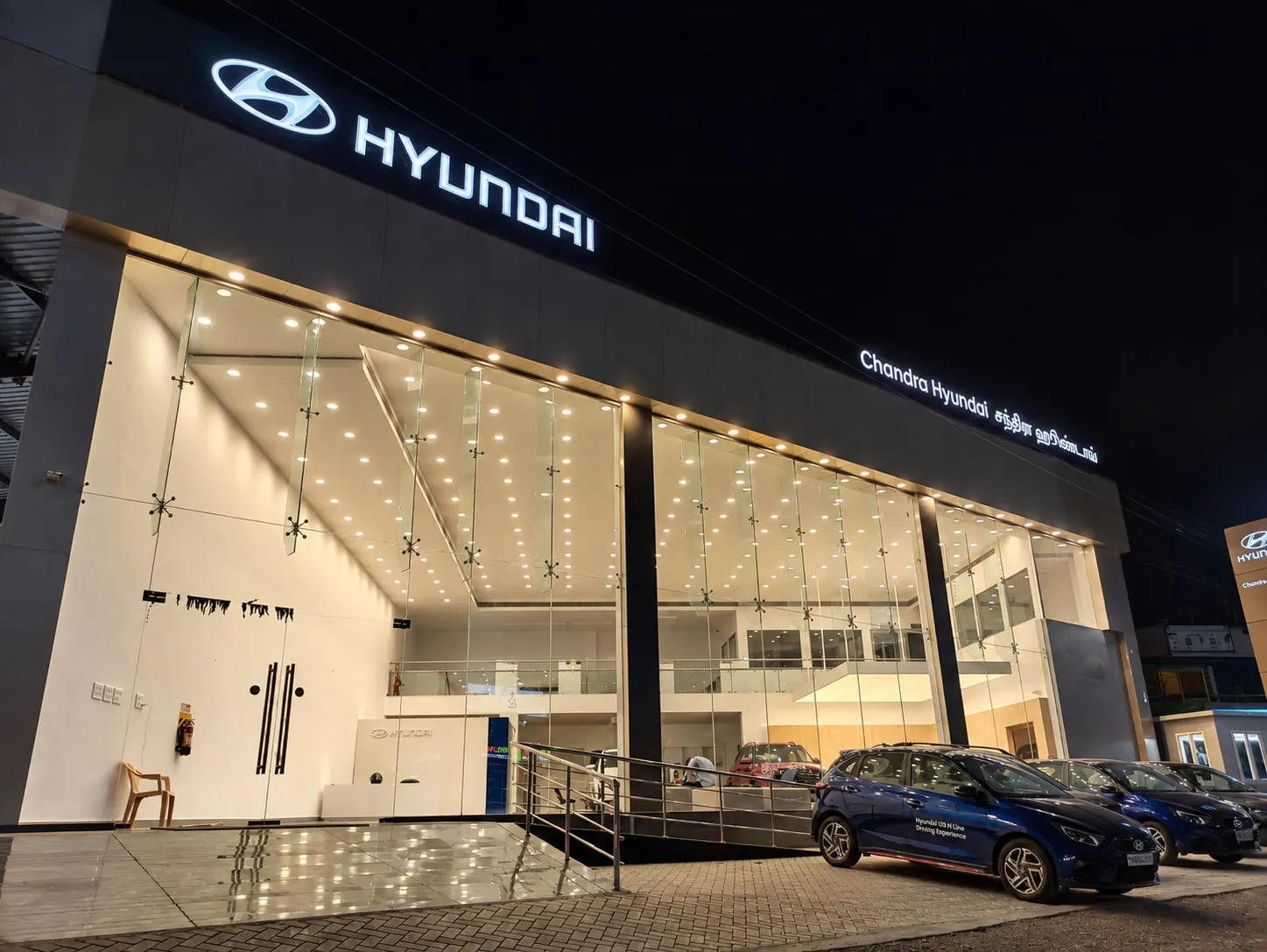
At this Hyundai dealership on Avinashi Road, the showroom front is a double-height wall of frameless glass held by stainless steel spider fittings, so the display floor and mezzanine are in full view from the road. Above the glazing, a dark ACP fascia band with a routed wave pattern carries the Hyundai logo and the dealer name in English and Tamil, set over a band of light-coloured ACP panels with downlights along the front. After sunset the interior lighting shines through the glass and the whole frontage reads as a lit display.
See the projectSpider glazing or structural glazing for a showroom front?
Spider glazing is the classic choice for automobile showrooms. Each toughened glass panel has holes drilled near its corners before it is toughened, because toughened glass cannot be cut or drilled afterwards. Stainless steel spider brackets pass through these holes and connect the panels to glass fins or a steel support frame. The result is a near-transparent wall with only small metal fittings visible, which suits double-height showrooms where the display floor should read as one open volume.
Structural glazing takes a different route: the glass is bonded with structural silicone to an aluminium frame that sits behind it, so the outside shows only glass and narrow sealant lines. It can be a better fit where the glass front sits within a framed opening, where the building cannot take point-fixed loads, or where the budget favours a framed system. Our engineers look at the height, span, support structure and the look you want before recommending one system over the other.
Getting the fascia, canopy and night-time look right
The fascia band is the part of a dealership that appears in every photograph, so its proportions deserve attention. We align ACP joint lines with the glazing grid below, keep panel widths consistent along the frontage, and fold returns at corners so that no raw panel edges are visible. Any patterned grooves or graphics routed into the ACP are set out on drawings first, so the pattern runs continuously across joints rather than breaking at each panel.
After dark, the showroom is effectively a lit shop window. We coordinate with your electrical and signage contractors so that cable routes, sign fixing points and downlight positions in the soffit are planned before the ACP goes up, avoiding later cutting of finished panels. Choosing a clear or lightly tinted glass for the display zone keeps the cars visible at night, while reflective glass, if used for heat control, is better reserved for areas where transparency matters less.
Car Showrooms we have delivered
Car Showrooms: common questions
Which type of glazing is best for a car showroom front?
Most dealerships prefer spider glazing for the main display face because it gives an almost frameless, double-height glass wall with only small stainless steel fittings showing. Structural glazing is a good alternative where the opening is framed or the structure cannot take point-fixed loads. Our engineers recommend a system after checking the height, span and support structure on site.
Can the ACP fascia match our car brand's corporate colour?
ACP is made in a wide range of solid, metallic and special finishes, and many brand colours have close stock equivalents. We compare the shade specified in your dealer design manual against physical samples before ordering, and share the sample with you for approval so there are no surprises once the fascia is installed.
Is a frameless glass front safe for a busy showroom?
Yes, when it is engineered properly. We use toughened safety glass, which is much stronger than ordinary glass and breaks into small blunt pieces rather than sharp shards. Laminated glass can be specified where extra protection is needed. Glass fins or a steel frame take the wind load, and frosted bands at eye level help people notice large glass doors.
Will a large glass front make the showroom too hot?
It can if the glass is chosen only for looks. Solar-control or tinted glass, double glazed units on harsh west or south elevations, and a projecting fascia or canopy that shades the glass all reduce heat gain. We discuss orientation and air-conditioning with you before finalising the glass, balancing comfort against how clearly the cars must be seen.
Do you take up showroom projects outside Coimbatore?
Yes. Our offices are in Coimbatore, and we take up facade, glazing and ACP work for showrooms across Tamil Nadu and Kerala. Send your drawings or site photos on WhatsApp, and our engineers will arrange a site visit to measure the frontage and prepare a free, site-measured quote for your dealership.
Discuss your car showrooms project
Send drawings or photos. We'll suggest a facade that suits your brand, budget and site.
Other industries
Request a quote
Send us your details. Your enquiry opens in WhatsApp and goes straight to our engineers.
Sources & standards
Technical statements on this page follow Indian standards and established industry references. Always confirm project-specific requirements with your architect or structural consultant.
- IS 16231 (Part 4):2019 Use of Glass in Buildings — Safety Related to Human Impact · Bureau of Indian Standards (Public.Resource.Org copy, Internet Archive)Indian code on safety glass in human-impact locations: doors, low panels, partitions, bathrooms and balustrades.
- IS 2553 (Part 1):2018 Safety Glass — Specification, Part 1: Architectural, Building and General Uses · Bureau of Indian Standards (Public.Resource.Org copy, Internet Archive)Indian specification for toughened and laminated safety glass, incl. nickel-sulphide spontaneous-breakage annex.
- IS 17682:2021 Aluminium Composite Panel — Specification · Bureau of Indian Standards (Public.Resource.Org copy, Internet Archive)Indian specification for ACP sheets: LDPE vs mineral (FR) core, skin thickness and coating requirements.
- IS 875 (Part 3):2015 Design Loads for Buildings and Structures — Wind Loads · Bureau of Indian Standards (Public.Resource.Org copy, Internet Archive)Indian wind-load code: basic wind speeds by city, cyclone factor and pressures on cladding and glazing.
- Storefront — Wikipedia · WikipediaDefinition of shop fronts and storefront glazing.
Planning a new facade or a makeover?
Talk directly to our engineers. Send photos or a drawing on WhatsApp and get practical options for your building.